Have you ever heard someone say “about face” and wondered what it means?
You’re not alone. People often see this phrase in military movies, books, conversations, or even workplace discussions.
Understanding its meaning helps you follow conversations more easily because it can describe both a physical movement and a sudden change in opinion or direction.
Quick Answer
| Item | Details |
|---|---|
| Meaning | Turn completely around or make a complete change in direction, opinion, or behavior. |
| Full Form | Not an acronym (no full form). |
| Pronunciation | uh-BOUT FAYS |
| Category | Idiom / Military Command |
| Tone | Neutral |
| Used On | Everyday conversation, military, news, business, social media, books |
| Difficulty Level | Easy |
| One-Line Definition | “About face” means to turn around completely, either physically or by changing your mind or actions. |
What Does “About Face” Mean?
The phrase “about face” has two common meanings.
1. Military Meaning (Original Meaning)
In the military, “about face” is a command telling soldiers to turn 180 degrees and face the opposite direction.
Example:
“The commander shouted, ‘About face!’ and the soldiers turned around instantly.”
Here, the phrase is a direct instruction.
2. Everyday Meaning (Most Common Today)
Outside the military, “about face” means making a complete change in your opinion, decision, plan, or behavior.
Example:
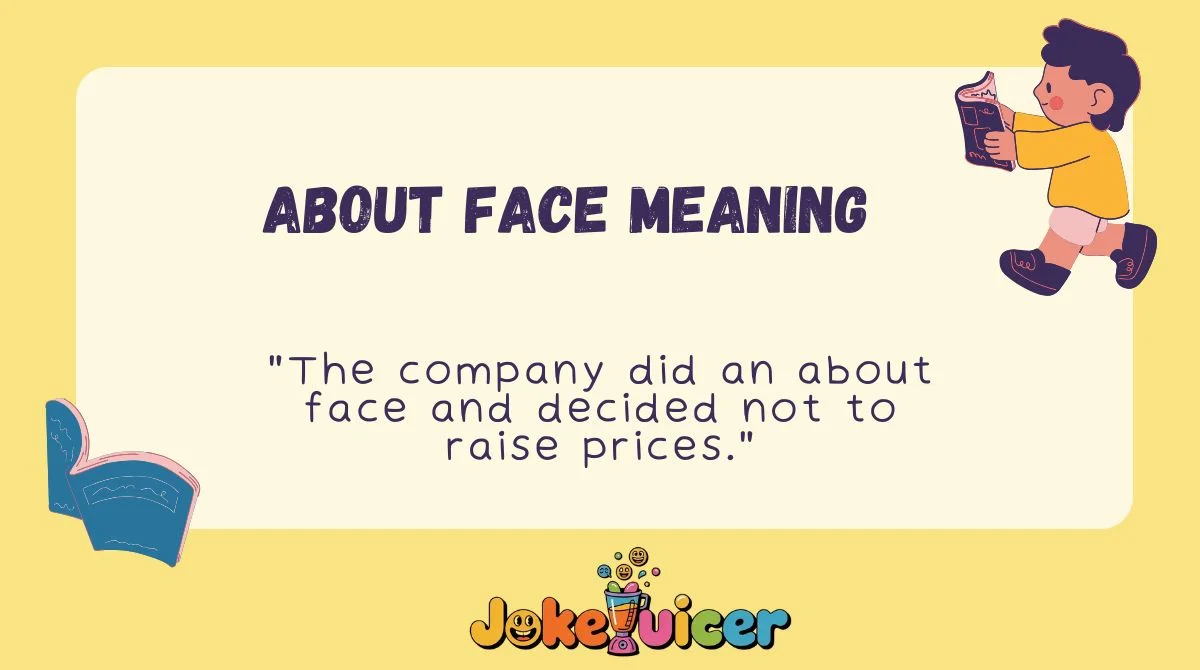
“The company did an about face and decided not to raise prices.”
This means the company completely changed its previous decision.
Where Did “About Face” Come From?
The phrase comes from military drill commands used for hundreds of years.
Soldiers needed clear instructions while marching. The command “about face” told everyone to turn around at the same time.
Over time, people started using it figuratively to describe any major change in direction, thinking, or policy.
Today, the figurative meaning is more common than the military one.
Why Do People Use “About Face”?
People use this phrase because it quickly describes a dramatic reversal.
Instead of saying:
“He completely changed his opinion.”
Someone might simply say:
“He did an about face.”
It’s shorter and sounds more expressive.
Different Ways “About Face” Is Used
Changing an Opinion
“She did an about face after reading the new research.”
Meaning: She completely changed her opinion.
Changing a Decision
“The school made an about face on its homework policy.”
Meaning: The school reversed its previous decision.
Changing Behavior
“He made an about face and started exercising every day.”
Meaning: He changed his lifestyle completely.
Physical Movement
“The instructor ordered everyone to do an about face.”
Meaning: Turn around.
Real-Life Examples
Example 1
A: I thought Jake hated cats.
B: He did an about face after adopting one.
Explanation: Jake completely changed his opinion.
Example 2
A: Is the event canceled?
B: No, the organizers made an about face and decided to continue.
Explanation: They reversed their earlier decision.
Example 3
Teacher: Last week the class wanted extra homework.
Student: Everyone did an about face after the first assignment.
Explanation: Their opinion changed completely.
“About Face” on Social Media
Unlike internet slang, “about face” keeps the same meaning across platforms.
Used in captions about personal growth.
Example:
“I did an about face and started focusing on my health.”
TikTok
Often describes lifestyle transformations.
Example:
“Watch my skincare about face.”
Common in discussions about politics, business, or life changes.
Example:
“The mayor made an about face after public feedback.”
Friends may use it casually.
“You said no yesterday. What caused the about face?”
Discord
Gamers sometimes use it jokingly when teammates suddenly change strategies.
Is “About Face” a Slang Term?
No.
It is an idiom that became popular through military language.
Most English speakers recognize it as a standard expression.
Is It Rude?
No.
The phrase is neutral.
It works in casual conversations, news articles, business writing, and formal discussions.
Is It Offensive?
Not at all.
There is nothing offensive about the expression.
Is It Flirty?
No.
It has no romantic meaning.
If someone uses it while talking about relationships, they’re simply describing a sudden change in feelings or decisions.
Example:
“He did an about face and decided he wanted to date again.”
When Should You Use “About Face”?
Use it when someone:
- Completely changes their opinion.
- Reverses a decision.
- Changes direction.
- Changes behavior dramatically.
- Literally turns around.
When Should You Avoid It?
Avoid using it when someone makes only a small adjustment.
For example:
❌ “She did an about face by leaving five minutes earlier.”
This isn’t a major change.
Better:
“She made a slight change to her schedule.”
Common Mistakes
Thinking It Means a Small Change
It doesn’t.
An about face is a complete reversal.
Treating It as an Acronym
It isn’t.
There are no initials or hidden words behind it.
Using It for Every Decision
Reserve it for significant changes.
A minor update isn’t an about face.
Similar Expressions
| Expression | Meaning | Difference |
|---|---|---|
| About face | Complete reversal | Strongest change |
| Turnaround | Improvement or reversal | Broader meaning |
| Change of heart | Emotional opinion change | Usually feelings |
| Reverse course | Change direction | Often used in politics or business |
| Backtrack | Withdraw a previous statement | Less dramatic |
Opposite Expressions
| Expression | Meaning |
|---|---|
| Stay the course | Continue with the same plan |
| Stand firm | Refuse to change |
| Hold your position | Keep the same opinion |
| Stick to your decision | Do not reverse your choice |
“About Face” vs. “Change of Heart”
| About Face | Change of Heart |
|---|---|
| Complete reversal | Emotional shift |
| Can involve actions or policies | Mostly feelings |
| Often used in news and business | Often used in relationships |
| Usually dramatic | May be gradual |
Common Questions
Does “about face” always mean changing your mind?
No.
It can also mean physically turning around.
Can businesses make an about face?
Yes.
Companies often make an about face by changing policies or strategies.
Is it only used in the military?
No.
Although it began as a military command, everyday English now uses it much more broadly.
Is “about-face” with a hyphen correct?
Yes.
When used as a noun or adjective, you’ll often see about-face, especially in edited publications.
Examples:
- “The company made an about-face.”
- “An about-face decision surprised investors.”
Without a hyphen, it’s also commonly written as about face, particularly when referring to the military command.
Frequently Asked Questions
What is the simplest meaning of “about face”?
It means making a complete turn around or completely changing your opinion, decision, or direction.
Is “about face” positive or negative?
Neither. It simply describes a major change. Whether it’s good or bad depends on the situation.
Can I use “about face” in professional writing?
Yes. It is widely accepted in business, journalism, and academic writing when describing a complete reversal.
Is “about face” an idiom?
Yes. It began as a military command and is now commonly used as an English idiom.
Why do people search for “about face meaning”?
Many people encounter the phrase in news articles, books, military contexts, conversations, or social media and want to understand both its literal and figurative meanings.
Conclusion
“About face” means making a complete turn or a complete change in direction, opinion, or behavior.
While it started as a military command instructing soldiers to turn 180 degrees, today it’s most often used figuratively to describe a dramatic reversal in decisions, beliefs, or actions.
If you hear someone say a person or organization “did an about face,” they’re saying something changed in a big and noticeable way—not just a little.

Alex Parker is a humor writer who loves crafting clever puns and lighthearted jokes that make people smile.