Have you ever heard someone say, “I’ll just chalk it up to experience,” or “Let’s chalk it up to bad luck”?
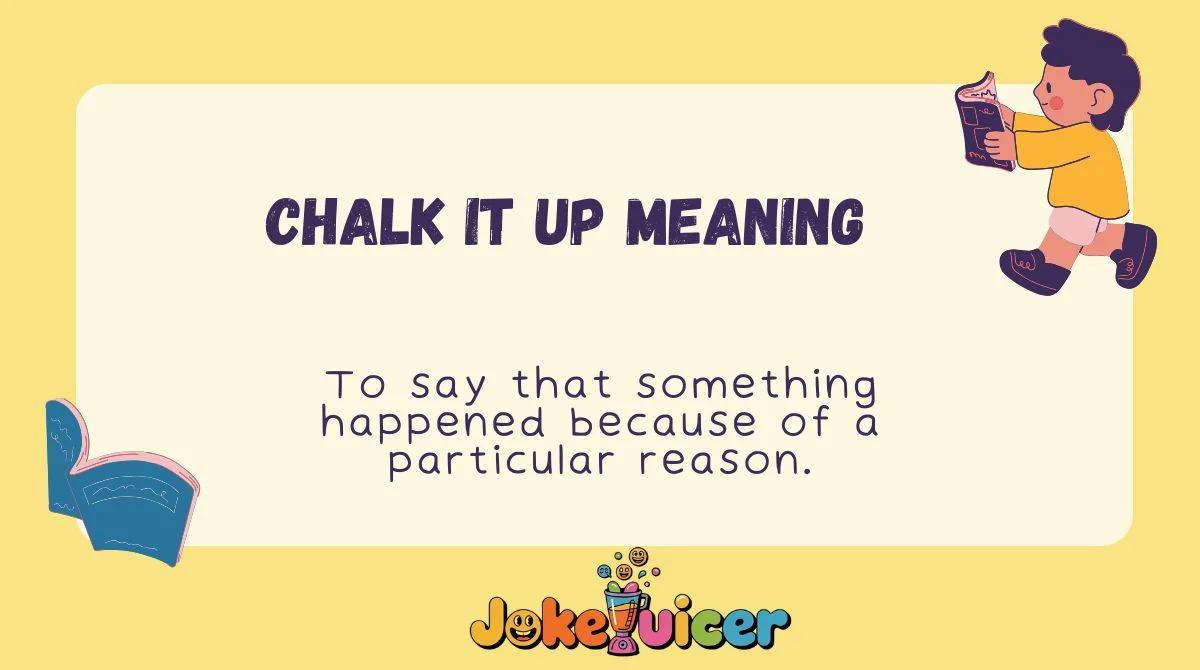
The phrase “chalk it up” means to accept that something happened because of a particular reason or treat it as a lesson without dwelling on it.
People search for this expression because it appears in conversations, books, movies, workplaces, social media posts, and everyday English.
Understanding it helps you sound more natural and avoid misunderstanding native speakers.
Quick Answer Box
| Item | Answer |
|---|---|
| Meaning | To explain something as being caused by a particular reason or to accept it as a lesson or experience. |
| Full Form | Not an acronym (no full form). |
| Pronunciation | Chawk it up (/tʃɔːk ɪt ʌp/) |
| Category | English idiom |
| Tone | Neutral, conversational |
| Used On | Everyday speech, work, school, social media, books, movies |
| Difficulty Level | Easy |
| One-Line Definition | “Chalk it up” means to attribute something to a cause or accept it as a learning experience. |
What Does “Chalk It Up” Mean?
The idiom “chalk it up” has two closely related meanings.
The most common meaning is:
To say that something happened because of a particular reason.
For example:
- “We lost the game, but let’s chalk it up to inexperience.”
It can also mean:
To accept a mistake or failure as something you can learn from instead of worrying about it.
Example:
- “My first business failed. I chalk it up to a lack of planning.”
In both cases, the speaker is choosing not to dwell on the situation but instead giving it an explanation or treating it as a valuable lesson.
Where Did the Phrase Come From?
The expression comes from a time when shopkeepers, taverns, and schools used chalkboards to keep records.
If someone bought something on credit, the amount was written in chalk on a board. Over time, “chalk it up” came to mean recording or assigning something to a particular account or reason.
Eventually, people began using it figuratively instead of literally.
Today, very few people think about actual chalk when they use the phrase.
When Do People Use “Chalk It Up”?
People use this expression in many everyday situations.
After a Mistake
Instead of blaming yourself forever, you accept the experience.
Example:
“I forgot the meeting. I’ll chalk it up to being tired.”
After Losing
Sports players often use it.
Example:
“It wasn’t our best day. We’ll chalk it up to bad weather.”
At Work
Managers may use it to encourage employees.
Example:
“The project didn’t go as planned. Let’s chalk it up to a learning experience.”
At School
Teachers and students use it after exams or assignments.
Example:
“I didn’t study enough. I’ll chalk it up as a lesson.”
In Everyday Life
Friends often say it casually.
Example:
“Wrong restaurant? Just chalk it up to a funny memory.”
Real-Life Examples
Example 1
Emma: I accidentally deleted my homework.
Lily: That’s frustrating. Just chalk it up to experience.
Explanation: Lily suggests learning from the mistake rather than staying upset.
Example 2
Jake: Why was the flight delayed?
Ben: Let’s chalk it up to bad weather.
Explanation: Ben believes the weather caused the delay.
Example 3
Sarah: I burned dinner again.
Tom: Everyone starts somewhere. Chalk it up to practice.
Explanation: Tom encourages Sarah to view the mistake as part of learning.
Example 4
Coach: We lost today.
Player: We’ll chalk it up to nerves and prepare better next time.
Explanation: The player identifies the likely cause and focuses on improving.
Is “Chalk It Up” Positive or Negative?
It depends on the situation.
Usually, it has a positive or accepting tone because it encourages moving forward.
For example:
- “Chalk it up to experience.”
This suggests learning instead of regretting.
Sometimes it simply explains something without emotion.
- “We can chalk it up to bad timing.”
Is It Formal or Informal?
The phrase works best in informal and semi-formal English.
You can use it with:
- Friends
- Family
- Teachers
- Coworkers
- Team members
In very formal writing, people may choose alternatives such as:
- Attribute it to
- Explain it by
- Consider it
- Regard it as
Common Situations Where You’ll Hear It
You may hear this idiom in:
- Daily conversations
- Movies
- TV shows
- Podcasts
- Interviews
- Sports commentary
- Business meetings
- Schools
- News discussions
- Social media captions
It isn’t tied to a specific platform like TikTok or WhatsApp. It’s simply a common English expression that people use anywhere they communicate.
Similar Expressions
| Expression | Meaning | Difference |
|---|---|---|
| Chalk it up | Attribute something to a cause or accept it as a lesson | Most common idiom |
| Learn from it | Gain knowledge from an experience | Focuses only on learning |
| Move on | Stop dwelling on something | Doesn’t explain the cause |
| Put it down to | British English equivalent meaning “attribute to” | Very similar in meaning |
| Take it as a lesson | Treat something as a learning experience | Emphasizes personal growth |
Opposite Expressions
Some phrases express the opposite idea.
- Hold someone responsible
- Place the blame
- Dwell on it
- Refuse to let it go
- Make excuses (depending on context)
These focus on blame or continued frustration rather than acceptance.
Common Mistakes
Thinking It Means “Give Up”
It doesn’t.
“Chalk it up” means accept and learn, not quit trying.
Using It for Every Situation
It works best after an event has already happened.
Incorrect:
“I’m chalking it up before the exam.”
Better:
“If I don’t do well, I’ll chalk it up to nerves.”
Assuming It Always Means Failure
Not necessarily.
You can chalk success up to something too.
Example:
“She chalked her success up to years of practice.”
Here, it means attributing success to a cause.
Can It Be Used for Success?
Yes.
Many people use it to explain why something went well.
Examples:
- “He chalks his confidence up to years of experience.”
- “The company chalked its growth up to excellent customer service.”
- “She chalked her improvement up to daily practice.”
In these cases, the phrase simply means to credit something to a specific reason.
Is It Rude?
No.
It’s a polite and widely accepted expression.
However, context matters.
If someone has suffered a serious loss, saying “Just chalk it up to experience” too quickly may sound dismissive. In sensitive situations, it’s often better to acknowledge their feelings first.
How to Reply When Someone Says “Chalk It Up”
Here are a few natural responses:
- “That’s a good way to look at it.”
- “I guess you’re right.”
- “Lesson learned.”
- “I’ll do better next time.”
- “Hopefully it won’t happen again.”
- “Thanks, I’ll remember that.”
FAQs
Does “chalk it up” always refer to mistakes?
No. It can describe both failures and successes by explaining their cause.
Is “chalk it up” an idiom?
Yes. It’s a common English idiom used in everyday conversation.
Is it common in American and British English?
Yes. Both varieties of English use it regularly, though British speakers may also say “put it down to” in similar situations.
Can I use it in professional conversations?
Yes. It’s appropriate in many workplace discussions, especially when reflecting on outcomes or lessons learned.
Is “chalk it up” slang?
No. It’s an idiom, not slang. It’s understood across age groups and in many English-speaking countries.
Conclusion
“Chalk it up” is a useful English idiom that means to attribute something to a particular cause or to accept an experience as a lesson and move forward.
Whether you’re talking about a mistake, a success, or an unexpected event, the phrase expresses acceptance and perspective rather than blame.
Once you understand it, you’ll notice it in conversations, movies, books, and everyday English—and you’ll be able to use it naturally yourself.

Alex Parker is a humor writer who loves crafting clever puns and lighthearted jokes that make people smile.