Have you ever seen the word “provoke” in a book, news article, social media post, or classroom and wondered what it means? Provoke means to cause someone to react, usually by making them angry, emotional, or by triggering a response or action. People search for this word because it’s common in everyday English, school assignments, debates, psychology, and online discussions. Understanding it helps you communicate more clearly and avoid misunderstandings.
Quick Answer Box
| Item | Answer |
|---|---|
| Meaning | To cause a reaction, emotion, or action in someone |
| Full Form | Not applicable (it’s a regular English word) |
| Pronunciation | pruh-VOHK (/prəˈvoʊk/) |
| Category | Verb |
| Tone | Neutral (can be negative or positive depending on context) |
| Used On | Everyday conversations, books, news, social media, schools, workplaces |
| Difficulty Level | Easy to Intermediate |
| One-Line Definition | Provoke means to intentionally or unintentionally cause someone to react emotionally or physically. |
What Does “Provoke” Mean?
The verb provoke means to make something happen by causing a reaction.
Most often, it refers to causing:
- Anger
- Annoyance
- Fear
- Laughter
- Thought
- Discussion
- Action
Although people often connect the word with negative emotions, provoke isn’t always negative. Someone can provoke laughter, curiosity, creativity, or meaningful discussion.
Simple examples
- “His rude comment provoked an argument.”
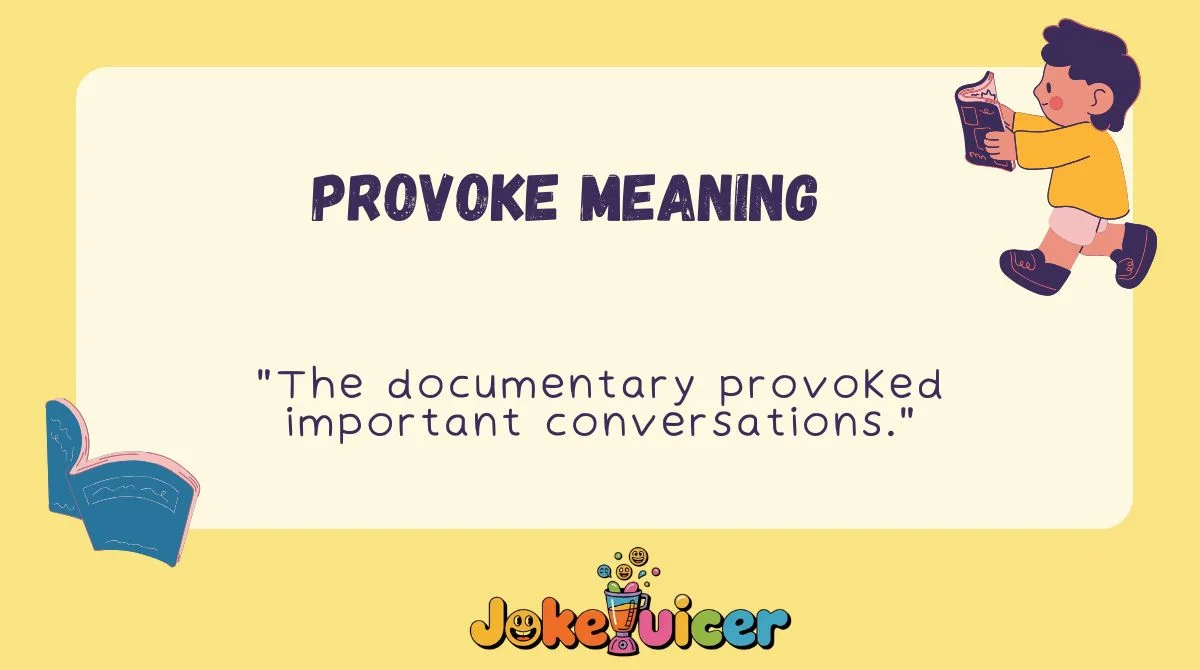
- “The documentary provoked important conversations.”
- “The joke provoked laughter from everyone.”
- “The speech provoked people to take action.”
In each example, provoke causes a response.
The Most Common Meaning
In everyday English, provoke usually means making someone angry or upset enough to respond.
Example:
“Don’t provoke your little brother.”
This means:
Don’t deliberately annoy him until he reacts.
This is the meaning you’ll hear most often in conversations.
Can “Provoke” Be Positive?
Yes.
Many people think provoke is always bad, but that’s not true.
Positive examples include:
- Provoking curiosity
- Provoking creativity
- Provoking thoughtful discussion
- Provoking change
- Provoking innovation
Example:
“The teacher asked questions that provoked critical thinking.”
Here, provoke means encouraging people to think deeply.
Origin of the Word
The word provoke comes from the Latin word provocare, meaning “to call forth” or “challenge.”
Over time, its meaning expanded to include causing emotional, physical, or intellectual reactions.
Today, it’s used in many different situations, from everyday conversations to science and psychology.
Different Ways “Provoke” Is Used
1. To Make Someone Angry
Example:
“He kept provoking his friend until they argued.”
Meaning:
He deliberately annoyed his friend.
2. To Cause an Emotional Response
Example:
“The movie provoked sadness.”
Meaning:
The movie made people feel sad.
3. To Start an Action
Example:
“The decision provoked protests.”
Meaning:
The decision caused people to protest.
4. To Encourage Thinking
Example:
“The article provoked debate.”
Meaning:
People began discussing the topic because of the article.
Real-Life Examples
At School
Teacher:
“This question should provoke discussion.”
Meaning:
Students should start talking about the topic.
At Home
Parent:
“Stop provoking your sister.”
Meaning:
Stop irritating her on purpose.
Online
Comment:
“He’s only posting this to provoke people.”
Meaning:
The post is meant to trigger emotional reactions.
At Work
Manager:
“The report provoked new ideas.”
Meaning:
It inspired fresh thinking.
Conversation Examples
Example 1
Alex: Why is everyone arguing?
Sam: His comment provoked the discussion.
Explanation:
The comment caused people to react.
Example 2
Emma: Why did she delete her post?
Lily: It provoked too many negative comments.
Explanation:
The post caused people to respond negatively.
Example 3
Teacher: What did the story provoke?
Student: It provoked curiosity.
Explanation:
The story made readers want to know more.
Where You’ll Commonly See the Word
Social Media
People often say:
- “This post is meant to provoke people.”
- “Don’t provoke the comments section.”
It usually means someone is trying to get strong reactions.
News
Examples:
- “The announcement provoked criticism.”
- “The decision provoked protests.”
News writers use provoke to describe events that trigger public reactions.
Literature
Authors may write:
“The speech provoked hope.”
This shows that provoke can describe emotional changes.
Psychology
In psychology, provoke often means triggering an emotional or behavioral response.
Example:
“Certain situations may provoke anxiety.”
When Should You Use “Provoke”?
Use it when someone or something:
- Causes emotions
- Starts arguments
- Encourages discussion
- Inspires action
- Triggers reactions
- Leads to change
When Should You Avoid Using It?
Don’t use provoke when no reaction is being caused.
For example:
❌ “She provoked to school.”
Correct:
✅ “She walked to school.”
Provoke always involves causing a response.
Is “Provoke” Rude?
No.
The word itself isn’t rude.
However, what someone is provoking might be rude or offensive.
Example:
- “He provoked an argument.”
The word is neutral, but the situation is negative.
Is “Provoke” Offensive?
Not by itself.
It’s simply a descriptive verb.
It only becomes offensive if the action being described is harmful or insulting.
Common Mistakes
Mistake 1
Thinking provoke always means “make angry.”
Actually, it can also mean:
- Inspire
- Encourage
- Trigger
- Cause discussion
Mistake 2
Using provoke without a reaction.
Incorrect:
“She provoked yesterday.”
Correct:
“She provoked laughter yesterday.”
Mistake 3
Confusing provoke with insult.
Someone may provoke without insulting.
Example:
Asking a difficult question can provoke discussion without offending anyone.
Similar Words
| Word | Meaning | Difference |
|---|---|---|
| Trigger | Causes a response | Often sudden or automatic |
| Inspire | Encourages positive action | Usually positive |
| Encourage | Gives confidence | Gentler than provoke |
| Stimulate | Causes interest or activity | Often used in education or science |
| Agitate | Makes someone upset | Usually more negative |
| Irritate | Annoys someone | Focuses on annoyance rather than any reaction |
Opposite Words
- Calm
- Soothe
- Comfort
- Ease
- Relax
- Prevent
- Discourage
Provoke vs Trigger
| Provoke | Trigger |
|---|---|
| Can be intentional or accidental | Often refers to an automatic response |
| Can be positive or negative | Frequently used for emotional or psychological reactions |
| Often involves encouraging a reaction | Often describes setting off an existing response |
Example:
- The question provoked debate.
- Loud noises triggered anxiety.
Frequently Asked Questions
Does provoke always mean making someone angry?
No. It can also mean causing curiosity, laughter, thought, discussion, or positive action.
Is provoke a negative word?
Not always. The context determines whether it’s positive, neutral, or negative.
What part of speech is provoke?
It is a verb.
Can someone provoke a good reaction?
Yes. A speech can provoke hope, a book can provoke curiosity, and a lesson can provoke creative thinking.
Is provoke the same as annoy?
No. Annoy means to irritate someone, while provoke means to cause any kind of reaction, including positive ones.
Can events provoke emotions?
Yes. Movies, speeches, news stories, music, and personal experiences can all provoke emotional responses.
Key Takeaways
- Provoke means to cause a reaction, feeling, or action.
- The reaction may be negative, positive, or neutral.
- The most common use is causing someone to become angry or respond emotionally.
- It’s widely used in everyday English, education, journalism, psychology, and social media.
- Understanding the context helps you interpret the intended meaning correctly.
Conclusion
The word provoke is more flexible than many people realize.
While it’s often used to describe causing anger or conflict, it can just as easily describe inspiring thought, sparking curiosity, or encouraging meaningful action.
Whenever you see provoke, ask yourself one simple question: What reaction is being caused? The answer will usually reveal the intended meaning.

Alex Parker is a humor writer who loves crafting clever puns and lighthearted jokes that make people smile.